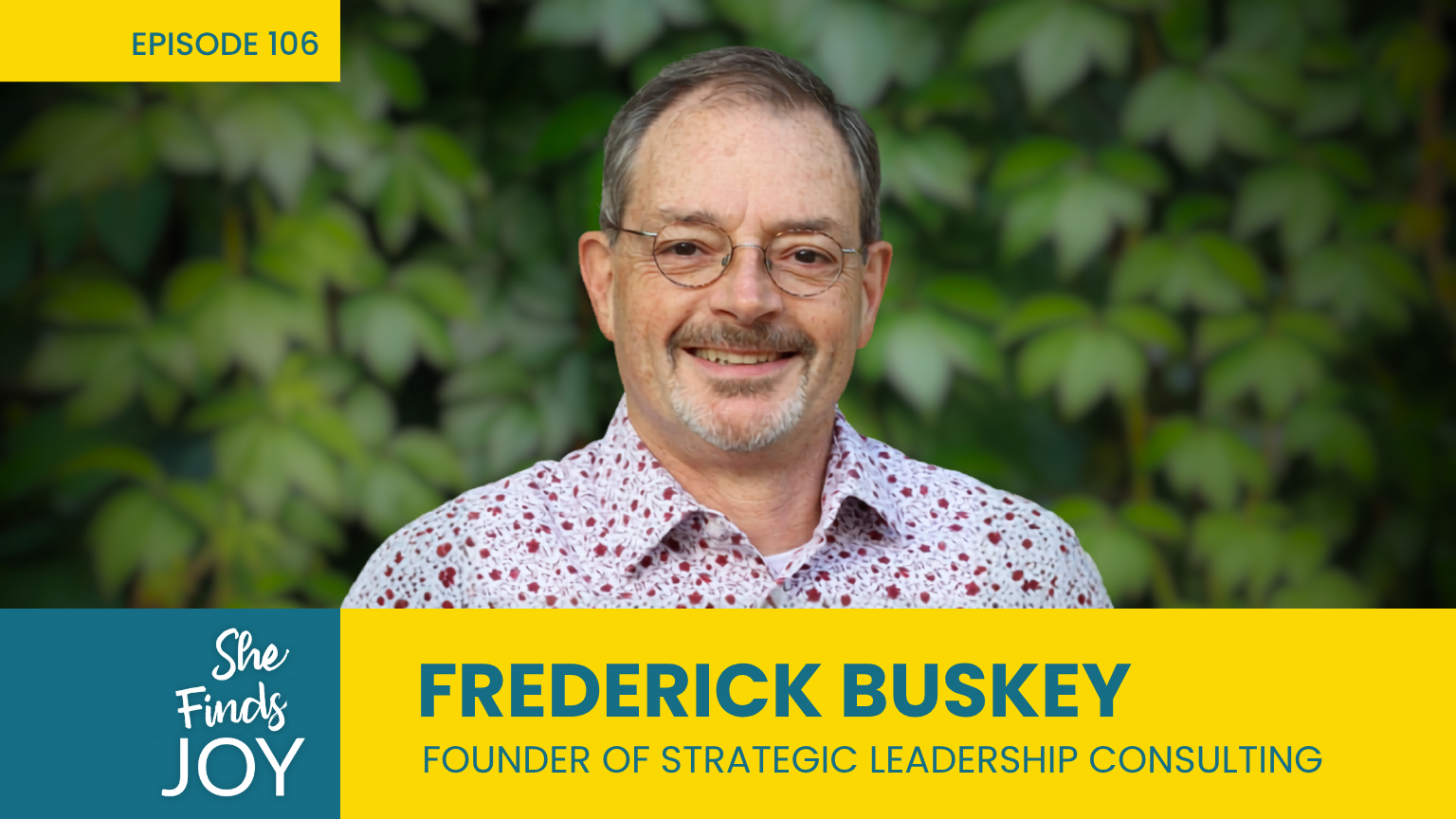
Kim Strobel:
Hello, everyone. I am super excited about today’s episode. I’m going to be interviewing Frederick butsky. Frederick has 17 years of experience teaching and leading in K12, internationally and in the US he has led total redesigns of principal licensure programs. He has this unique, unique combination of personal experiences. And what he’s going to talk to us about today is really understanding motivation. What fires us up, what gets us to take action, what makes us make moves in our life. So welcome to the show, Frederic. All right, Frederic, I’m so happy to have you on this podcast today to talk about one of my favorite subjects, which I think I know a lot of, but I think you’re going to 100% increase my knowledge base on this idea of motivation and how it works and what it is and why we get stuck. And I think you kind of have a little bit of a solution sometimes to our problems. So welcome to the she Finds Joy podcast.
Frederick Buskey:
Thanks, Kim. Thank you. Yeah, I think, you know, motivation is one of those things that has many meetings. If you go to the research, you’re not going to find one definition. Like, each discipline and area of science has its different way that they define it, and I think we all use it a little bit differently. So I like to describe motivation as being the willingness and the ability of a person to do the thing that we want them to do. So I’m thinking about it in a leadership context. Can we get the person, are they willing and able to do the thing we want them to do? And, and I think about kind of three phases of this motivation. So the first phase is the task face. Right. Is my 8th grade student Bettina gonna do her math homework? And then we have the skill face, which is when we’re trying to implement and do something new. So will a teacher implement an instructional math practice for Bettina? And then the third one is the behavior face, and that is will people or oftentimes will we implement new behaviors? So I think those are the three basic faces, and then for each of those there’s an ugly face. But I don’t know if you want to dive into more before we go into that.
Kim Strobel:
Well, I do have some questions. What was the second face called?
Frederick Buskey:
The second face is the skill face.
Kim Strobel:
Yeah. Okay. And so I’m thinking of this both. So there are definitely teachers and, and school leaders that listen to this podcast, but then we also have just a lot of people who are in the self help field and they’re wanting to improve their lives. And so I’m gonna let’s Just use me as an example. So people think that I have high motivation levels, and I do, and I have a lot of discipline in my life, but there are certain areas that I have struggled to move the needle on. So let’s take my example, Frederic, of at times really not being able to implement healthy eating habits. So the task face is, will Kim make healthy choices in her food options today? Is that correct?
Frederick Buskey:
Yeah. So the. The task is something that’s very discreet. Right. So it’s just this event right now. If you’re talking about changing the way you eat, we’re talking about a change of behavior.
Kim Strobel:
Okay. Okay.
Frederick Buskey:
So the task is. The task is discreet, and generally we’re assuming that you know how to do the task.
Kim Strobel:
Okay.
Frederick Buskey:
You know how to prepare a nutritious dinner.
Kim Strobel:
Yep. And I have the skill set for it. It’s.
Frederick Buskey:
You have the skill set.
Kim Strobel:
The behavior face is the one that’s getting in the way for a lot of us.
Frederick Buskey:
Yeah, yeah, we. We know. We know how to go down to the gym. I know how to get up at 5:30 in the morning. I know how to put my workout clothes on. I know how to drive down there. But. But it’s hard. And I think that’s understanding it. This is, to me, where the motivation equation comes in. And the motivation equation is simply value or motivation equals value divided by effort.
Kim Strobel:
Yes, let’s talk about that.
Frederick Buskey:
So if I see a high value and low effort, I’m going to be very motivated. So if I walk out my door and there’s a $100 bill three steps away, that’s a high value, low effort, three steps, I’m going to go grab that bill. But if I walk out of my house and I see, I don’t know, a block away, a penny on the sidewalk, I’m probably not going to walk a block for the penny. Right. Because the value is low and the effort would be high.
Kim Strobel:
Yes. And so when we have people have these goals, whether it’s they want to implement an exercise routine, they want to make better, healthy choices with food, they want to get themselves to the gym, they want to start a gratitude practice, they want to do things that bring them peace and ease and happiness and wellness. So I always say, like, when it comes to happiness, everybody wants to be happy and happier, Frederic. So why is it that when it comes to anything, what you’re saying, it’s so individualized? So I’m thinking about somebody that I know who has resisted exercise her entire life, and she has all of these health impediments now that are somewhat a direct result of her not choosing to exercise. But no matter how dire the circumstance is, nothing ever has made her choose a different behavior. And I want you to help me understand that from that lens, because we all get frustrated when people continue to make really poor choices, and we see that it’s having a direct effect on their health, wealth, whether it’s, you know, saving money, their health, their wealth, their happiness. We. We all do this. I do this too, right? Like, I’ve got the exercise part down, but I don’t honor myself with the food eating habits. So explain this in a way that helps us, one, be able to loosen our grip over other people’s actions or inactions and understand that it’s all individualized.
Frederick Buskey:
Yeah. And just to be clear, I am not a motivational expert or anything like that. Right. So I’m not trying to. To dig into science. One of the things I try to do is to make it simpler for people to think about motivation and to think about it in a way that’s a little more positive. Is one of the things that we do is we put a lot of judgment when we don’t do the thing. Right. And I always do this thing with. With teachers and school leaders where, where we talk about this exercise piece, right? And how many of us have done a New Year’s resolution and we’ve wanted to eat better, work out, whatever, and then we fail. And what do we say about ourselves, Kim? We say, oh, we’re undisciplined. If I was just more disciplined. And I mean, we’re talking rooms of leaders. You don’t get to be a principal by being undisciplined. You don’t be a great mom by being undisciplined. Right. And so part of the problem is that the way we look at failure during motivation is that we put judgment. And so what the motivation equation helps us do is to stop judging and instead get curious and ask a question that you just asked, like, what’s going on? If I know, right, that if I know that if I go down to the gym, I’m going to live longer. If I do that consistently, I know that I have the skills to be able to go down and do the right exercises. So I know this stuff. So why don’t I. Why don’t I go down? And I think. I think the behavior face is the hardest face. Right. The task base and the. And the skill face, we can work on those. This one’s hard. I think there’s a couple things Happening on the value side, I think a big driver of value is immediacy. So if I can give you one thing that is going to make your life better right now, a tiny bit better right now, that is worth way more than me giving you a book and saying, if you read this book three months from now, your life will be transformed. Like, the further away it is, the less valuable. And that’s one of the things that’s so hard, I think, about taking care of ourselves. Right. We had that value piece. It’s so far off.
Kim Strobel:
Okay, I’m going to stop you for a minute because I think that really speaks volumes. And so we all love immediate satisfaction. We all love that. And so what you’re saying is, a lot of times I’m taking a person I know who just feels so lost from her life and she’s just like so upset with her body and she’s so upset with the way it looks. And she’s tried for years to try to make herself get back into an exercise routine. And it’s kind of helping me see why she can’t take action, maybe is because it’s also like, it feels like I’m not going to see results for months. And so it doesn’t. And I’m not even sure at this point I even believe my body can be changed because I’m so down the tubes. So I don’t see the value. Even though somebody else is trying to tell me the value, I can’t see the big picture of it enough to buy into it right now, to put the effort in because the outcome is so far away. I see.
Frederick Buskey:
Yeah, I think that’s. That’s a piece of it. And I wonder also if there’s again, around the kind of taking care of ourself theme. I think there are counter narratives that play in our head that offer value competition. Right. So, yes, I know I should take care of myself and I will live longer and I’ll be healthier and happier and. And at the same time, if I sacrifice my health because I’m too busy taking care of everybody else, that actually feeds a different value. Right. So I can value my personal health, but I can also value my self image as somebody who sacrifices for others. And sometimes I think those things can compete against each other and make it more difficult.
Kim Strobel:
Yeah, it’s true. Because in particular, I hear women say, I just wish I had some time for myself. I just wish I had some space for myself. But when I say things like, what if your spouse was the one that put the kid to bed instead of you at least half the time. Well, I don’t that my kid counts on me to do that. Like, I want to be the mom that reads the story every night. So what you’re saying is it would be helping them just understand that they are placing a higher value on that than they are. So they might want peace of mind and the ability to de stress, but it’s so important for them to be that mom that can say, I do this every single night and if I don’t do it, I’m going to feel guilty. And I don’t want to feel guilt. So I’d rather feel stressed over here that I’m not doing the thing to take care of myself because I don’t want to have to feel guilt.
Frederick Buskey:
Yeah. And a positive twist on that. So I was just working with a nonprofit leader last week and we were having this discussion because one of the tasks that I had set for them was to look at improving their morning routine. And so we were breaking down like, why, if you can’t get your morning routine the way you want it, why? What’s happening? And she said, I’m focusing all my attention on my kids. And we talked about, okay, well what would it look like if your kids were more independent and could eat breakfast and could fix their own breakfast or at least take steps in that direction? And she just said, no, I really, I like making them breakfast in the morning. So again, it’s that values, that’s a trade off. Right. And that’s not saying it’s bad to want to take care of your kids and make your kids breakfast in the morning. That’s pretty awesome. But understanding then where the value trade off is.
Kim Strobel:
And do you ever then sometimes though help them challenge these crazy expectations that one places on themselves? Do you ever help them? Like I always say, everything that you’re a yes for, yes, I’ll make the kids breakfast. Yes, I’ll do yes, yes, yes. You’re also intentionally a no to something else. Right. So she wants to do the breakfast. And probably she’s a pretty spectacular mom and wants to do all of these things so that she can feel good as her role and responsibility of mother. But then is part of your work ever helping them see, though, that sometimes we do need to make different choices so that we can be a better version of ourselves to everyone around us.
Frederick Buskey:
Yeah. So a big part of my work focuses around purpose. And again, I work with school leaders a lot. So our purpose is people. How do we support and grow our teachers? So we have better outcomes for kids. And I think parenting is pretty close to that as well. And what I teach in terms of purpose, staying focused on your purpose, is really being mindful of the difference between a priority and a task. And too often when we get caught in urgent mode, we’re reacting, and when we’re reacting, what we’re doing is we’re focusing on tasks. And so the. The other way to operate is to be driven by people and priorities instead of tasks and urgency. And I think that helps us be more mindful of the yes and no, because I love that every yes is a no to something else. And I think one of the problems is we don’t do. We don’t make those decisions intentionally. We just say yes, yes, yes to the first thing that comes along. Not really thinking about all the things where the no’s are piling up behind us. Right? But if we stop thinking about the tasks and we start thinking about, okay, well, what. What do I really want to achieve? What are my priorities? Now I start to make my decisions more intentionally and a little bit differently and say, oh, wait, no, this thing actually isn’t as important as this other thing over here.
Kim Strobel:
So knowing that we have school leaders on this podcast, let’s run through an example of a task versus a priority and how you might help them to look or shift their thinking around that.
Frederick Buskey:
So if I think a typical one is a lot of the kind of the administra that comes with leadership, right? I got to fill out the report. I have to answer the emails. I need to. I need to proof the parent newsletter, right? And so all these things are on my list. So I wind up just trying to work down and check through my list. And. And the thing I don’t get to is checking in on my new teacher, who I know is struggling a little bit, but I’m too busy taking care of my tasks to go prioritize that person and check in there. So understanding priority management, what I do is I make really intentional decisions about what’s actually more important. And is answering this email more important than going down and investing five minutes with that teacher down the hall? I mean, maybe if it’s from the lawyer or the superintendent or something, yeah, I need to do that. But many times we get caught up in things that really aren’t that important or that we don’t even have to be the ones to do, Right? If I’m a busy school leader, why am I proofing the parent newsletter? I have lots of competent people around me that can do that. Job?
Kim Strobel:
Yes. Yeah. Oh, yes. I mean, I’m just having so many thoughts because, like, I. I have. I don’t know if you’ve ever taken the Colby Index, but it’s like one of the many personality tests. You know, there’s the Enneagram that shows you how you operate in your life, and of course, you know, all those different quizzes. But I’m a Colby. Quick, quick start. And, well, of course, my anxiety and my. I. I didn’t know this, Frederick, until recently when my nurse practitioner reached out and said, kim, have you ever been tested for adhd? And I’m like, why would you think that, Haley? Like, it’s enough that I have anxiety. Why do you think I have adhd? And she’s like, I’m just kind of getting the feeling that we should test you for that. And so she goes through these questions, and she’s like, I’m thinking, oh, I don’t have this. She’s like, you know, are you kind of. Oh, no, I’m very organized. Everything’s structured and organized in my life. Haley. No, I don’t have. But then she starts talking about the sense of urgency, the facetiousness, the reacting quickly, the impulsivity, and I’m like, I. I scream that. And so it’s even making me think about Frederic. Just today, the number of times I like my inbox just overwhelms me, and if I don’t keep it cleaned up, I. I’m in such high anxiety. But I’ve got three proposals that are going to generate money if I can just get them out today. But I’m over here scared to death, just responding, responding to these silly emails just to try to get my anxiety levels under control. So, like, what. What would you say to somebody who, like, you’re saying, like, how do we get ourselves to just pause? Because, like, my purpose is to get these darn proposals out for. So we can serve these schools and I can bring. You know, it’s important to bring money in to this business, but I’m over here dinkering around with these emails that are just getting on my nerves.
Frederick Buskey:
Right, so why are you more motivated to do the emails than the proposals?
Kim Strobel:
Right, Please answer that question.
Frederick Buskey:
So you’ve got competing values, right? Which one value is, I have the business, and I can go help these people if I can get this proposal out. But another value is I like surety, and I like to be organized and like to know that there’s not stuff that’s piling up there. Right. That I know everything so those two values are competing against each other. And then I think the other side of the equation we haven’t talked about is effort.
Kim Strobel:
Yes.
Frederick Buskey:
Right. And so in a sense, and when we talk about immediacy of payoff, it’s much easier to open your inbox, check a couple emails off the list, because you’re getting instant value. I did this, I did this, I did this. Whereas those proposals, even once a proposal’s done, you then have to send it out, and then you gotta wait. Right. So it’s long term. And so even that small thing, it feels like, okay, at least I got. I got something done. So I think one of the things that we can do if we want to change behavior is we have to make doing the thing we don’t want to do harder and make doing the thing we do want to do easier. Okay, so I’ll give an example, because email is one of those things too. Right. And we know there’s no reason I need to be in my email. Anybody who needs me instantly has my phone number. And if they don’t have my phone
Kim Strobel:
number, they don’t need me.
Frederick Buskey:
My wife, who just retired from university in June, so she has now started doing my email. And what she does is I have three folders. I have my Power Hour folder, which is dealing with clients. I have my podcast Power Hour folder, which is anything related to podcasts. And then I have a Priority 1 folder. Everything else gets archived. So she now goes through my inbox. She archives stuff that, that I don’t really need to see, and then she puts the other stuff in those other folders. So now my inbox is usually empty. I know that I don’t need to go check it.
Kim Strobel:
And she does that once a day. Twice a day.
Frederick Buskey:
Once or twice a day. But. But I don’t. But the thing is, it’s an effort thing. Just knowing that she has taken care of it makes it easier for me to ignore it.
Kim Strobel:
Yes.
Frederick Buskey:
As not important. I mean, does it functionally make a difference? Not. Not really. Except I’m not attention switching all the time. I’m not task switching. I just don’t go do it. Because that’s the other thing, Kim. Right. It’s not. It’s not that the 15 seconds that you got distracted that you went and looked at the email, it’s one that happens three or four times, and it’s the changing in what’s going on in our minds and our change of focus, and then we get tired and then we’re not as effective. Yeah. So I Don’t know that that’s a great example, but increasing or decreasing. I like to use the term friction. So, for instance, I know I meditate now before I ever get out of bed. If I get out of bed and I haven’t meditated, there’s a good chance that I won’t. Is meditating while I’m laying down in bed ideal? No, not really. But by giving myself permission to do that, I’ve erased a friction point. And it’s really easy for me to reach over and put my phone and choose something and put it on and then meditate. Another thing that I’ll do is I’ll put my workout clothes out on the stairs or wherever I need to change the night before so that when I get up in the morning, they’re right there. It doesn’t sound like a big deal, but when you’re trying to convince yourself to go do something that you really don’t feel like doing, because I’d rather just sit and have an extra cup of coffee. Everything that we can do to make it flow easier. You know, you and I were talking about backpacking, I think, before we got on, because I’m a. I’m an avid backpacker. The hardest part of backpacking for me is stepping out my own front door. I love to go. I do this thing, I call it the 24 hour soul cleanse. So I’ll leave. I’ll bug out early on a Friday afternoon, go into the mountains. I live in the the Blue Ridge Mountains. It’s gorgeous here. I’ll run out, hike in four or five miles, camp out, and then hike back. I’ll get back Saturday before noon, right? 24 hours. And I just feel better. But I don’t do it nearly as often as I should. And so thinking about ways that I can decrease the friction so people can’t see it. But I’ve got a backpack hanging on the wall here, right? So that’s my reminder. But that pack is packed. There’s a tag on the pack that lists the five things that I need to add. Food, sleeping bag, a couple other things that have to go in there before I can take off. But I could be ready in 15 minutes. So setting things up that way so that it makes it easier for me to go. Right when I decide, yeah, I really should go now, it’s really easy. I just throw these three things in. I don’t even have to think. I look at the list and I’m out the door. So I think looking at ways that we can decrease friction is really important.
Kim Strobel:
Okay, I. I love what you’re saying to me, the terminology. I love the word friction, because that’s what it is. But I call it engineering your environment for success. And so it reminds me of, like, if you don’t. If you. So I have this obsession with Russell Stover creme eggs, Frederic. It’s ridiculous. I don’t know if you’ve ever heard of them, but I’ve liked them since they only come out at. And they like maple cream or strawberry cream. And so I have had an obsession. Like, the obsession is. I’m scared to tell you this about me, Frederick, because you will judge me. You just won’t be able to help yourself. But I buy those and have for years by the case. And one time I ate 143 of those stupid eggs in three weeks time. This was like in my 20s, okay? So every year I used to buy cases and cases because they only come out once a year. And so every year I say, like, this year I really thought I would get a handle on it because I have been doing better with my sugar intake. So I just told my husband last week I did not order a case of those. I bought like 12 of them and ate them, but I did not buy a case until two days ago when they popped up on the screen. And then I bought a case. So now I have not engineered. Because here’s the thing, Frederick. I will eat all 18 of those eggs that come in that case regardless. Because now they’re in my home, right? So there’s hardly any friction there. I go walk to the buffet and I grab one and I eat it. And. And so I’m thinking about this. And the other thing I would tell you is, like, I had it on my radar this week on Sunday, that I. I was going to meal prep for the first time. I started watching these Instagram videos and I didn’t want Scott and I eating out so much this week. So I was going to meal prep, but then I just haven’t made it to the grocery store yet, so I haven’t done the meal prep. And now it’s Tuesday afternoon. And tonight when I’m really tired at the end of the day and my husband is too, we probably look each other and go like, hey, do you want to go eat at Lock and Kill tonight? Yes, let’s go. Right? Because I have not set myself because there’s so much friction, if I would meal prep, I take away some of the friction and I reduce our ability to kind of make choices that aren’t the best for us. And so it’s about deciding what behavior you want to change. And then it’s about understanding that this formula is motivation equals the value you place on something and the amount of effort it’s going to take. So if it’s going to. If you don’t place a ton of value and it is going to take a lot of effort, you probably aren’t going to do it. Maybe. But if the value is high and you can remove some friction so that the effort is at least a little bit lower, you increase your chances of being able to implement that new behavior.
Frederick Buskey:
Yes. It’s funny because Fruit Loops are my go to stress food, which, I mean, they’re terrible for you.
Kim Strobel:
I love those too.
Frederick Buskey:
And I know when I’m in the grocery store, if I say no to buying Froot Loops, then I only have to say no once. But as soon as I buy the box, now I have to say no every day, right? Yes.
Kim Strobel:
That’s a great example. And it’s also making me think about. So I’m a Facebooker and I have a pretty good following. And I also don’t like. I have these timer settings on my phone that say, okay, you have now spent 50 minutes, Kim, on all your apps. And so I have allocated 50 minutes. But for the last two months, I just keep ignoring it. Every time it goes, I just ignore it. And I was doing really well before. So today on my run, you’re going to be proud of me. I was running and I was thinking, why do you have to click on Facebook so much when you’re stressed over here? And then you’re like, oh, I’m just gonna click on Facebook for a minute and see how many likes I got or who liked my post. And so today, Frederic, on my run, I got to thinking that one of the reasons I click on it is because I want to see who liked my latest post, Right? And I want to see who commented. And I want to see that throughout the day. If I made a post that morning, I want to see that throughout the day. So I got to thinking, what if I just didn’t post? Like, I usually post once a day, Monday through Friday. What if I took that down and I only did three posts and I didn’t do a post on Tuesday and Thursday, I think that I wouldn’t be as interested as clicking on it because I’m not worried about seeing who’s liking it. So maybe if I just remove that post, then I free myself a little bit up from this distraction. Does that make sense? Am I thinking about that the right way?
Frederick Buskey:
Yeah, I guess.
Kim Strobel:
I don’t know. You tell me.
Frederick Buskey:
Yeah, well, and it. But it drives right back to that point about immediacy, because again, when you look, you’re getting rewarded by seeing the thumbs up. My version of this is checking the number of podcast downloads, Right. When we drop a podcast on Tuesday, how are my downloads coming? And I have a friend, and we’ve joked about checking multiple times a day. In. In the case of social media, you may see something that you want to respond to, and so maybe there’s something there. In the case of podcast downloads, it doesn’t matter whether I know how many podcasts are being downloaded throughout the day or not. Right. I mean, my looking at isn’t going to influence anything. I think one other thing that I want to touch on before we wrap it up is, is the bar and this idea of winning or losing. So I’m very competitive, so I have gamified my days. So every day I either win the day or I lose the day. And then based on my five work days, I either win the week or I lose the week. If I go 3 and 2, then I win the week. And I know that if I had three winning days, then it probably was a pretty decent week. Now, I don’t suggest that people do that because it’s. It’s kind of overkill, but I.
Kim Strobel:
If you’ve won a day or not, what’s that? How do you judge if you won the day or not?
Frederick Buskey:
Yeah, so I have criteria. And, and so part of my criteria involves, is around movement, Right. Did I get out and I do. Did I do a block of movement? So maybe that’s get up in the morning and do yoga. But what, what counts as movement, I can raise or lower that bar. So if I’m really. If I’ve been struggling or what I want to do is I want to build some momentum and I want to build success. Right. Success builds momentum. So if I haven’t been doing my yoga in a while, like, I had knee surgery back in December, and it’s been just really tough to get back into it. If I do 10 minutes of yoga, that’s a win, right? 10 minutes is all I need.
Kim Strobel:
Yes.
Frederick Buskey:
Because there are a lot of days where I think about doing 30 minutes. There’s no way I’m going to do it. I’m just not. Yeah, but I can do 10 minutes.
Kim Strobel:
Right.
Frederick Buskey:
The other thing I do, this sounds silly, but if I drive down to my gym, that’s a win. I don’t even have to walk in the door. If I drive down, that counts as a win because I know once I get down there, I’m going to walk in the door, I’m going to do something. Right. But I put a low bar on it. If a win is working out for two hours, that’s really hard. But if I just have to drive down there, okay, and then maybe I’ll walk in the building and I’ll do three exercises and I’ll leave, that’s a win.
Kim Strobel:
Yes.
Frederick Buskey:
So I think we can manipulate that satisfaction that we get by lowering the bar so that we can accumulate a series of wins. And what inevitably happens for me, I do 10 minutes of yoga, and then I do 12, and then I do 10. But then I build the momentum, and a month Later, I’m doing 30 minutes consistently because I’ve built the momentum and I’ve made it back into being part of my routine. And. And I find it to be comforting. And it’s not as, you know, as challenging as it was before when I was starting out.
Kim Strobel:
Okay, so to make this about me, Frederic, now, because I’m going to ask you to help me, let’s say that, like, I am really, I am. I’m frustrated at the number of times I click on my social media apps a day. I think I am more frustrated by the number of times I have to check in than I am the number of minutes I spend a day. Because I mean, 50 minutes a day on all my social apps. I mean, it’s not great, but it’s not crazy. Right?
Frederick Buskey:
Right. Right.
Kim Strobel:
So how could I. Because I really want to remove. And I boy, my brain is just dopamine hit. Dopamine hit. It’s an addictive type of brain. I think. What would I. Somebody like me who says I don’t want to do that so much where. How could I both reduce friction, which I’m thinking right now? I don’t know, maybe this would be too extreme. But like to. I have a time limit that says after 6pm all my apps go out gray out, but I tend to click on them. But so do I need to maybe take my phone to the bedroom and say my phone’s going to stay back there after 6pm or is that too extreme? Like where. Where do I start if I want to make a small little movement so I feel a little success in it and it doesn’t feel overwhelming to me?
Frederick Buskey:
Yeah. I think about two things. One is how can you introduce more friction into checking in so that it’s harder to check in. And what, you just identified a strategy, right? Park your phone somewhere away from you. Because that, I mean, that’s what I find. If my, if my phone is in the kitchen and I’m sitting down to eat, I’ll look at my phone. If my phone is in my office and I’m sitting down to eat, I won’t look at the phone. Right? So, so that’s a huge thing because if I have to get up and go check it, that makes it harder to do it, right?
Kim Strobel:
Yes.
Frederick Buskey:
So, so I think that’s one strategy. Another thing is to think about what’s, what’s the trade off in the behavior? Like what, what can you do instead that is a little bit healthier than, than checking in on the social media. Can you. When, when you have that and you need to just kind of like I need to step away, I need to get my brain disengaged for, for just a minute or I need to feel like I accomplished something. Are there really small tasks that you can have kind of queued up that then you can do one of those things and that provides that, that little bit of separation and okay, I got something done and then, then you move back. You know, I have a, I have a daily email list, so for me that might be okay. I don’t have, I can’t complete this big thing right now. I don’t want to go scroll on media. But you know what? I can take five minutes and I can complete this post and I’ll do the post and then I can get back to whatever my task is.
Kim Strobel:
Well, you know, I’ve told my husband this weekend that I have this passion project inside myself. I want to become a flower gardener. So like, this is far off, but like, wouldn’t it be great, Frederic, if I put my phone down at 6pm and I got to go out and spend an hour working in my flower garden doing something that actually fuels me versus my phone that drains me. You know, like swapping out to where you actually feel like you’re, you’re choosing something else that brings you joy. In fact, something that doesn’t just bring you joy for three seconds, but like removing. Not just removing myself, but, but also kind of distracting myself, like throwing myself into another activity that I’m immersed in. That all that brings me joy, that’s also helping me adhere to my boundary.
Frederick Buskey:
Yeah, I, I think we have to understand though. I mean, we want what you’re saying. Yes. And we do need to understand that like social media has been engineered based around the way our brain works. So we shouldn’t judge ourselves for being drawn to. To social media because they engineered it. Exactly. So that we would become addicted. So give yourself some. Some grace and. Yeah. Then try to engage in some of those replacement behaviors.
Kim Strobel:
Well, and I’m going to wrap this up by going back to something that you said at the beginning that really struck me. So we’re really judgmental of ourselves when we don’t adhere to a goal that we’ve made for ourself or a habit or a practice. And we’re also really judgmental of others when we can’t figure out why they aren’t taking care of their stuff in their life. And you said, what if you replaced judgment with curiosity?
Frederick Buskey:
Yeah.
Kim Strobel:
And. And, boy, doesn’t that feel just lighter? And isn’t that more productive? You know, instead of just immediately berating myself, like, just getting curious about why I keep choosing those behaviors, like with the healthy eating, I choose it because it’s fast, it’s convenient. I haven’t engineered my environment for success and created less friction by doing a little meal prep on Sunday. And so I understanding kind of like I’m setting myself up for failure. But then you said, like, we see failure and then we judge ourselves for the failure. And here’s what my therapist of 20 some years has taught me, Frederic. Shame gets us nowhere. Shame never changes behavior. Really. It doesn’t help us in any shape, form, or fashion, but getting curious does. And I love that. So thank you for sharing that. I feel like Frederick needs to coach me on a lot of things in my life.
Frederick Buskey:
I’m busy, still trying to coach myself. Yeah, I like to say judgment leads to conflict, curiosity leads to collaboration. Right.
Kim Strobel:
Judgment leads to conflict, curiosity. Oh. Oh, my gosh. Okay, I’m just going to share. So my husband and I, we had couples therapy this morning. We are married for 25 years, and we are happy much of the time in our marriage, but we’re still growing and learning together. And one of the things we don’t do well, Frederic, is I listened to this podcast from Mel Robbins last week with this love and relationship expert, and he said, at the end of the week, take 10 minutes and ask your partner, what are three ways that I loved you? Well, this week, what are three things I did that made you feel loved? And I love that, Frederic, because he says, like, we just don’t really know what’s making the other person feel loved. And when we hear it, we’re like, oh, that’s what made you feel loved. And Then we’re both motivated to do more of that. But we’ve also, like, shown our partner, you know, how we love them. But he said, it’s also really important to say, and where did I miss the mark this week? Is there something I did that made you feel unloved? And so we were talking with our therapist this morning. We haven’t had a couple’s therapy session in a couple years, but we always do individual. And I said, I’m nervous about that second question, because my sweet husband can get triggered easily if I give any kind of feedback. And I do, too, at times because my ego gets in the way. So, like, how can we emotionally hold space for that and not let that turn into, like, he and I getting defensive? And he simply said, just when that person shares that this kind of hurt me this week or it made me feel a little bit unloved, you then, as the partner say, can you tell me more about that? And I was like, that’s beautiful. Because if Scott says, well, Kim, when you mouthed off about my family last week, it really hurt me. Then I go into, like, defensive mode. Like, well, I don’t. You know, I don’t know why that hurt you. I was just telling you the truth, you know, and so there’s no, like, oh, hey, Scott. So can. Can you help me understand that a little bit more? How did it hurt you? Or why did it feel so bad? And that’s the part he and I have to improve on. We’re really good at filling each other’s cups and. And loving each other in big ways. But when we have to kind of talk a little bit about the hard stuff, it gets a little. You know, even after 25 years, it’s a little. It’s a skill set we’re still working on. And so it just kind of reminds me of what you were saying about getting. Getting curious.
Frederick Buskey:
Yeah. Yeah.
Kim Strobel:
And now, Frederick, you have something to implement with your wife at the end of the week. Three ways you love me. Well, and one thing I could do better.
Frederick Buskey:
Yeah, I like that. That’ll be helpful.
Kim Strobel:
Oh, thank you so much for being here today, Frederica. I really learned a lot from you, and I know that I could learn so much more, but I appreciate your knowledge and your examples and that you’ve been able to tie it both to school teachers, school leaders, and the rest of us who are all trying to improve our lives.
Frederick Buskey:
You’re very kind and gracious. Thank you so much, Kim.
Kim Strobel:
All right, friends, I am closing in here after the episode with Frederic, which I really loved where we learned about motivation. It’s value divided by effort. I want to close this by letting you all know that I’m going to take a little bit of a sabbatical from the podcast. It may last this summer, may come back to it in the fall. I’m not really sure, but I have to practice a little bit of what I preach, and I have a lot of things that are taking my time and energy and attention right now. And so I need to remove a few things from my plate, and one of those, for now, is creating the podcast. It takes a lot of time and effort for me and my team, and so I’m just needing to create a little bit of ease and flow in my own life. And so this is the last episode, and then I’m going to reconsider bringing it back in the fall, but we’ll see where I land. But thank you so much, so much for being here and for being a part of this, and I do hope I come back with more episodes later.